


PostgreSQL as a Data Warehouse: When It Works, When It Doesn’t (2026)
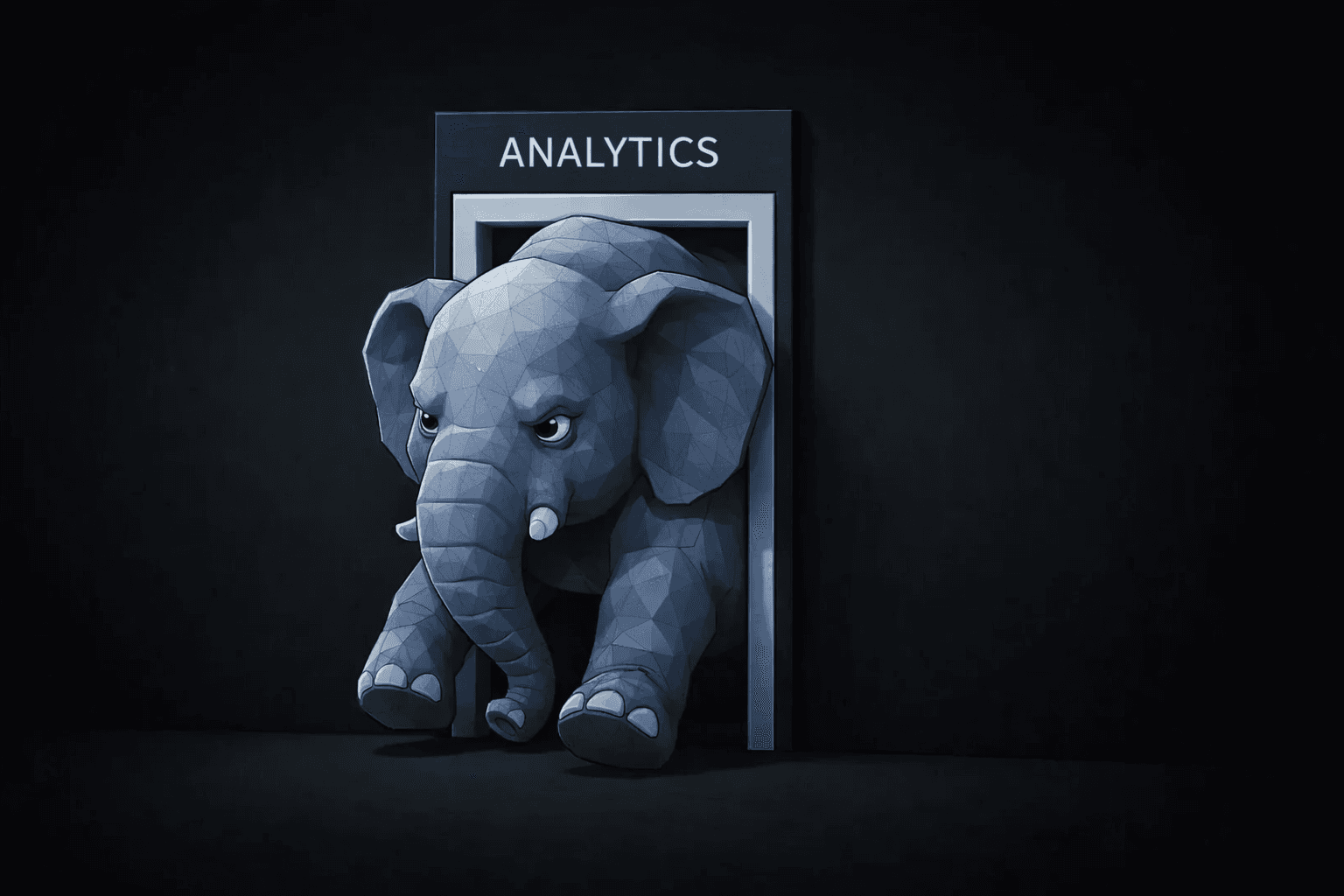
Everybody loves postgres. We get it – we use it too. It's capable, reliable, and familiar. There's a reason PostgreSQL powers millions of applications—including parts of Definite's own platform.
So when someone asks, "Can I just use Postgres as my data warehouse?" the appeal is obvious: no new tools to learn, no additional vendors, no learning curve. (The same question applies to SQL Server—and the full cost calculus is often surprising.)
But using PostgreSQL as your data warehouse is a different question than using it as your application database. The honest answer? PostgreSQL can work as a data warehouse. But knowing what we know now about modern alternatives, we wouldn't choose it for that workload—and neither should you.
Here's why, and what to do instead.
The OLTP vs. OLAP Divide
Before we get into specifics, let's clarify what makes data warehousing different from application databases.
OLTP (Online Transaction Processing) is what PostgreSQL was built for. It handles the transactional workload of your application: user signups, purchases, updates. OLTP needs to be fast, consistent, and handle lots of small writes.
OLAP (Online Analytical Processing) is what data warehouses do. OLAP handles analytical workloads: historical data storage, complex aggregations, time travel queries, and read-heavy reporting. OLAP needs to scan millions of rows quickly and return aggregated results.
PostgreSQL can handle both—technically. But optimizing PostgreSQL for OLAP requires significant engineering effort: columnar extensions, partitioning strategies, indexing decisions, query tuning, and infrastructure scaling. By the time you've built all that, you've spent months and thousands in engineering costs—before you've answered a single business question.
Modern OLAP engines are purpose-built for these workloads. They offer features like time travel (query your data as it existed yesterday), ACID-compliant historical snapshots, and columnar storage that makes analytical queries 10-100x faster. At Definite, we use DuckLake for exactly this—bringing data lake flexibility with data warehouse reliability.
"Just Use a Replica"
The common workaround is running analytics against a read replica to avoid impacting production. This solves one problem (production performance) but none of the others: you're still querying row-based storage, still need ETL to bring in data from Stripe, HubSpot, and other SaaS tools, and still face replication lag when you need real-time answers. The replica approach also doubles your infrastructure costs and maintenance burden without improving query performance for analytical workloads. (We wrote up the exact quantitative thresholds where the read-replica + materialized-view stack hits a wall — and the 1–2 sprint move that fixes it. On Supabase, the replica math is concrete: a replica bills at your primary's compute size, with no plan credits.)
PostgreSQL's Real Benefits (And Their Limits)
To be fair: PostgreSQL is free, uses standard SQL your team already knows, handles diverse data types, and has decades of community support. These are real benefits—especially for application development. But "free software" often means "expensive engineering," and community support doesn't come with an SLA. For data warehousing specifically, the limitations add up fast.
The Hidden Costs: PostgreSQL Limitations for Data Warehousing
Now for the reality check. These limitations don't matter much for OLTP, but they add up fast when you're trying to run a data warehouse.
Row-based storage vs. columnar storage
PostgreSQL stores data in rows. That's efficient for transactional workloads where you're reading or writing complete records. But analytical queries typically scan specific columns across millions of rows—calculating sums, averages, and aggregations.
Columnar storage (used by modern OLAP engines like DuckDB) stores data by column, making analytical queries dramatically faster. The difference isn't marginal—it's often 10-100x for typical aggregation queries.
This is why Definite runs on DuckDB instead of PostgreSQL for analytics. We migrated from Snowflake to DuckDB and saw 70%+ cost savings while maintaining sub-second query performance. One Series A SaaS company that moved from Postgres-based analytics to Definite cut their average dashboard load time from 12 seconds to under one second, without any query tuning.
Version management and dependencies
Whatever version of PostgreSQL you choose needs to be compatible with your ETL tools, data transformation frameworks, and BI platforms. Version upgrades require testing across your entire stack. This creates ongoing maintenance overhead that pulls your engineering team away from product work.
Security and compliance
Open-source software requires constant security monitoring. PostgreSQL vulnerabilities need patching, access controls need hardening, and compliance certifications (SOC 2, HIPAA) require documentation and auditing. For a startup without a dedicated security team, this is another engineering burden.
Load-balancing at scale
As your data grows, PostgreSQL needs load-balancing and replication. The official PostgreSQL documentation lists several different approaches for high availability—each with trade-offs, configuration complexity, and operational overhead. Choosing the wrong approach early can mean painful migrations later.
Support for urgent issues
When your data warehouse breaks at 2 AM before a board meeting, you're relying on community forums, Stack Overflow, or expensive consultants. There's no guaranteed response time, no SLA, no one to call who knows your specific configuration.
The Fragmented Stack Problem
Here's the real issue: using PostgreSQL as a data warehouse doesn't eliminate complexity—it distributes it across multiple tools.
To make PostgreSQL work as a data warehouse, you'll need:
ETL/ELT tools (Fivetran, Airbyte, or custom scripts) to move data from your SaaS tools into PostgreSQL
Data modeling tools (dbt) to transform raw data into useful metrics
BI/visualization tools (Looker, Metabase, Tableau) to create dashboards and reports
Monitoring infrastructure to track pipeline failures, data freshness, and query performance
Security and access controls across all these systems
Each tool requires setup, maintenance, and often separate subscriptions. Your CTO is now managing 3-5 different systems, each with its own learning curve, failure modes, and vendor relationships.
PostgreSQL + ETL tool + BI tool: Still weeks of setup, multiple vendors, complex pricing, and data engineering expertise required. Use our Data Stack Cost Calculator to see what this actually costs. For a detailed breakdown of what this fragmented approach runs at each growth stage, see our B2B SaaS data stack cost guide.
DuckDB vs. PostgreSQL: The Technical Difference
Since we're being specific about alternatives, let's compare PostgreSQL to DuckDB—the analytical database that powers Definite. (If you're also evaluating cloud warehouses like Snowflake, BigQuery, or Redshift, see our Snowflake alternatives comparison — or, if you're specifically GCP-leaning, our BigQuery alternatives breakdown walks through when to optimize versus replace.)
| Aspect | PostgreSQL | DuckDB |
|---|---|---|
| Optimized for | OLTP (transactions) | OLAP (analytics) |
| Storage format | Row-based | Columnar |
| Query performance | Fast for row lookups | Fast for aggregations |
| Concurrency | Many small queries | Fewer large queries |
| Best use case | Application database | Data warehouse |
DuckDB was purpose-built for analytical workloads. It uses columnar storage, vectorized query execution, and automatic parallelization to make analytical queries fast without manual tuning.
At Definite, we combine DuckDB's query performance with DuckLake for ACID-compliant storage, time travel, and historical snapshots. You get the reliability of a data warehouse with the flexibility of a data lake—without managing any of the infrastructure.
Time-to-Value: The Startup's Biggest Constraint
Let's talk about the metric that matters most for startups: how long until you can answer business questions with data?
PostgreSQL path:
- Week 1-2: Set up infrastructure, configure networking, security
- Week 3-4: Build ETL pipelines, handle data quality issues
- Week 5-8: Create data models, define metrics, build dashboards
- Month 3+: Ongoing maintenance, pipeline failures, scaling issues
Fragmented cloud stack (PostgreSQL + Fivetran + Metabase):
- Still weeks of setup across multiple tools
- Complex pricing across vendors
- Requires data engineering expertise for maintenance
Definite:
- 30 minutes from signup to first insights
- Connect your data sources (500+ pre-built connectors)
- Define metrics in the semantic layer
- Start asking questions—in SQL or plain English
Teams typically get their first dashboard live within 30 minutes of signing up. While competitors are still setting up their data stack, you're already making data-driven decisions. (Want the step-by-step? See our startup data stack setup guide.)
AI-Powered Analytics: The Modern Advantage
Here's what the 2021 data warehouse conversation completely missed: AI.
In 2026, the best analytics platforms don't just store and visualize data—they help you understand it. AI analytics—natural language queries, automated insights, and intelligent recommendations—aren't nice-to-haves; they're the difference between data that sits in a dashboard and data that drives decisions.
What AI analytics looks like in practice
Natural language queries: Instead of writing SQL, ask "Show me revenue by customer segment this quarter" and get an instant answer. No SQL required, no waiting for an analyst.
Automated insights: AI detects anomalies, trends, and opportunities in your data. "Churn rate spiked 15% last week" surfaces automatically, not after someone thinks to check.
Smart recommendations: The system suggests relevant metrics and visualizations based on your questions and past queries. It learns what matters to your business.
Self-service for everyone: Non-technical team members can get answers without waiting for SQL-savvy analysts. Your marketing lead can check campaign performance. Your CEO can pull board metrics. No gatekeepers.
Why this matters for your engineering team
When analytics is self-service, your engineers stop being the bottleneck. No more "can you pull this data for me?" interruptions. No more one-off SQL queries for the sales team. No more maintaining dashboards that someone asked for once and forgot about.
Definite's AI Assistant (Fi) lets anyone on your team ask questions in plain English and get answers instantly. Your engineers stay focused on product work instead of becoming reluctant data analysts—and everyone else gets the insights they need without waiting.
What could your data tell you?
Enter your domain and we’ll show you the business questions your tools can already answer — you just can’t ask them yet.
Try it with any company domain — no signup required.
The Easiest AND Best Path Forward
Here's the key insight: you don't have to choose between easy and good.
Old thinking said: "Simple tools are limited. Powerful tools are complex." That trade-off doesn't exist anymore.
Definite is both the easiest transition from PostgreSQL thinking AND the best solution for modern data analytics:
Easiest because:
- SQL-compatible: Your existing SQL knowledge transfers directly
- 30-minute setup: No weeks of infrastructure configuration
- Self-service: Non-technical users can get insights immediately
- Managed platform: No maintenance, no scaling decisions, no 2 AM pages
Best because:
- 500+ pre-built connectors: Connect everything from Stripe to HubSpot to your production database
- Built on DuckDB: Columnar storage, vectorized queries, sub-second performance
- Governed semantic layer: Consistent metrics across your organization
- AI-powered: Natural language queries, automated insights, intelligent recommendations
- Open standards: DuckDB, Iceberg/Parquet—no vendor lock-in
For startups evaluating options
If you're deciding between PostgreSQL-as-a-data-warehouse and managed alternatives, Definite is the easiest transition because:
- Your SQL skills transfer directly
- Your mental model (warehouse → semantic layer → metrics) stays the same
- The complexity disappears into a managed platform
For new builds
Skip the PostgreSQL data warehouse setup entirely. Start with Definite from day one and avoid the technical debt. You'll have insights in 30 minutes instead of 3 months.
For existing PostgreSQL warehouses
If you've already invested in PostgreSQL as a data warehouse, Definite can ingest your existing data. Migration is straightforward—you're not throwing away your work, you're upgrading it.
Cost Comparison: PostgreSQL "Free" vs. Total Cost of Ownership
Let's do the math on PostgreSQL being "free."
PostgreSQL data warehouse "free" includes:
| Cost Category | Estimated Monthly Cost |
|---|---|
| Engineering time (setup + maintenance) | $8,000-15,000+ |
| Infrastructure (servers, backups) | $500-2,000 |
| ETL tool (Fivetran/Airbyte) | $1,000-5,000 |
| BI tool (Looker/Tableau) | $1,000-3,000 |
| Security/compliance work | $500-2,000 |
| Total | $11,000-27,000+/month |
Definite:
- Transparent, predictable pricing
- Complete stack included (ingestion, warehouse, BI, AI)
- No separate tool subscriptions
- No engineering maintenance time
The "free" database often costs more than a purpose-built platform when you account for total cost of ownership. One 40-person e-commerce team consolidated from a Postgres warehouse plus three separate tools onto Definite and went from $2,400/month in analytics spend to $250/month.
Wrap Up: PostgreSQL Is Great—Just Not for This
PostgreSQL is an excellent database. We use it ourselves. It powers critical parts of our platform.
But using PostgreSQL as a data warehouse means taking on infrastructure complexity, maintenance overhead, and engineering burden that modern alternatives have eliminated. You can build a data warehouse on PostgreSQL—but the question is whether you should when there's a better way that's also easier.
The bottom line: PostgreSQL can work as a data warehouse. But for startups that need insights fast without the engineering overhead, Definite is the modern alternative. Get started in 30 minutes, not months. Get AI-powered analytics that anyone on your team can use. And focus your engineering time on your product, not your data infrastructure.
Ready to See the Difference?
Unified: All your data in one place. 500+ connectors bring product, ops, and SaaS data into Definite automatically. No separate ETL tools, no separate warehouses, no separate BI platforms.
Simple: True self-service. Your team doesn't need SQL expertise or data engineering skills. The Canvas interface works like a spreadsheet, and the AI Assistant answers questions in plain English.
AI-Powered: Answers in plain English. Ask "What's driving churn this month?" and get instant insights. No SQL required, no waiting for analysts, no gatekeepers.
Open: No lock-in. Built on open standards (DuckDB, Iceberg/Parquet). Export your data and queries anytime. Your data, your control.
Get started with Definite or watch the demo to see how it compares to building your own PostgreSQL data warehouse.