


Your Salesforce Data Warehouse Doesn't Need Five Vendors

Your CEO asks "What's our pipeline velocity by region?" and the honest answer is: you can't pull that from Salesforce. Not without custom report types, formula field workarounds, and a prayer that cross-object reporting cooperates.
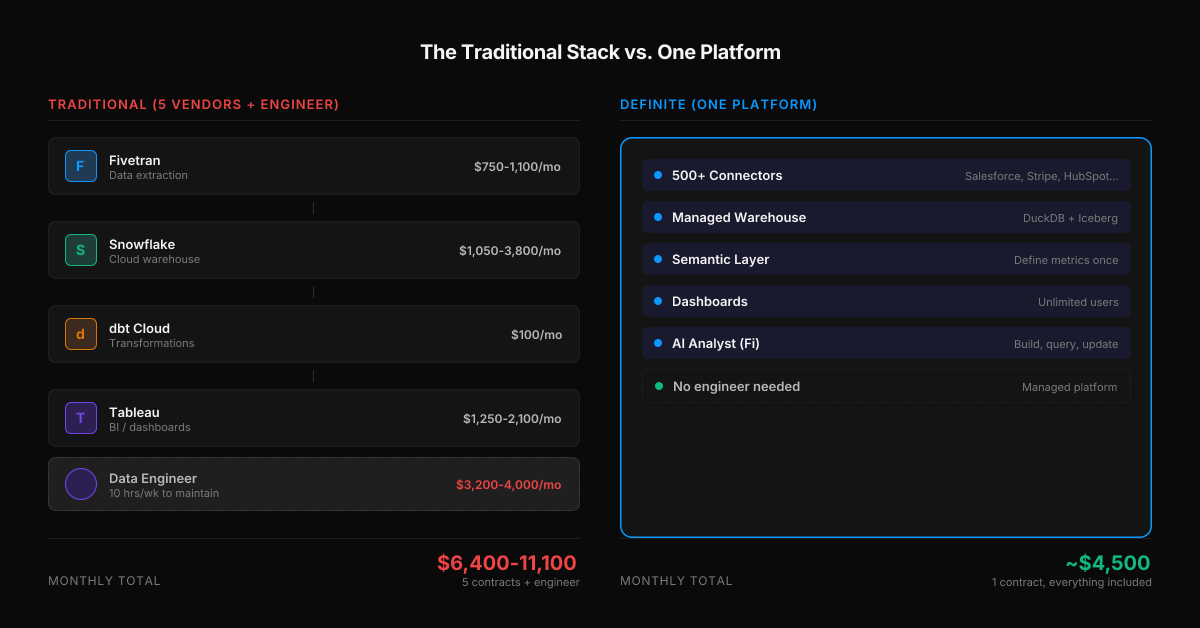
You've heard the solution is a data warehouse. Simple enough in theory. In practice, you're looking at four vendors, four contracts, and—based on our data stack cost calculator—$6,400-11,100/month before you've answered a single question.
You shouldn't have to become a data infrastructure company to answer revenue questions.
A Salesforce data warehouse is an external database that pulls CRM data out of Salesforce so you can join it with billing, product, marketing, and support data in one queryable place. The standard approach uses 4-5 separate tools (ETL, warehouse, transformation layer, BI) and costs $6,400-11,100/month for a mid-size team. This post breaks down the real costs, explains why Salesforce Data Cloud doesn't solve the cross-source problem, and shows a single-platform alternative that replaces the entire stack.
You Already Know Salesforce Reports Hit a Wall
You don't need convincing that Salesforce's native reporting has limits. You've hit them: cross-object queries that require SOQL workarounds, custom report types that still can't join the data you need, API call limits that throttle any attempt to pull data out at scale, and Einstein Analytics that costs more per seat than the CRM itself—without solving the underlying problem. (If you're also evaluating ETL tools for Salesforce, the extraction question is only the first of many.)
Your revenue story lives across Salesforce, Stripe, HubSpot, your product database, and a dozen other systems. Your board, your finance team, and your marketing department all need access to the answers, but at $75-300/seat/month, you're not giving everyone a Salesforce license just to view a dashboard.
The question isn't whether you need a data warehouse. It's how to build one without assembling five vendors.
How Much Does a Salesforce Data Warehouse Actually Cost?
The conventional approach looks straightforward: an extraction tool to pull data, a warehouse to store it, a modeling tool to organize it, and a BI tool for dashboards. Each excellent at its job. Together, they create a system that requires ongoing integration work, specialized expertise, and constant maintenance.
For a 200-person B2B company connecting Salesforce plus five other data sources (Stripe, HubSpot, your product database, Google Analytics, Intercom):
| Component | Monthly Cost |
|---|---|
| Data extraction (Fivetran, 6 connectors) | $750-1,100 |
| Cloud warehouse (Snowflake) | $1,050-3,800 |
| BI tool (Tableau, ~30 seats) | $1,250-2,100 |
| Transformation tooling (dbt Cloud) | $100 |
| Subtotal (tools) | $3,200-7,100 |
| Part-time data engineer (10 hrs/wk) | $3,200-4,000 |
| Total Monthly Cost | $6,400-11,100 |
That's $77,000-133,000 per year—and you still haven't answered your first RevOps question. The typical scenario lands around $80K.
See what your specific stack would cost →
The Part That Requires a $150K/Year Hire
The dollar cost is only part of the story. There's also the time and expertise it takes to make it all work.
Implementation takes months. Configuring connectors, setting up warehouse schemas, writing transformation models, and building dashboards takes 3-6 months for most teams. Your RevOps questions can't wait that long.
Ongoing maintenance is a job in itself. Pipeline failures need troubleshooting. Schema changes in Salesforce break downstream models. Warehouse query costs need monitoring and optimization. Someone has to maintain this system—usually a data engineer earning $150K or more per year.
Your extraction tool syncs data; it doesn't join it. You still need someone to write the SQL that connects Salesforce opportunities to Stripe invoices to product usage data. Metrics like Net Revenue Retention require custom modeling that doesn't come out of the box.
You're now managing five vendor contracts, three support queues, and a Slack channel called #data-pipeline-fires. The cognitive overhead alone slows teams down. (Curious what your current stack looks like? Paste your URL and get an instant analysis →)
Why Not Just Use Salesforce Data Cloud?
Salesforce's own answer to this problem is Data 360 (formerly Data Cloud), starting at $60,000/year for 10 million data service credits and 5TB of storage. It can unify data within the Salesforce ecosystem and offers zero-copy connections to Snowflake and BigQuery. But it has the same limitation as native reporting: it's built around Salesforce's data model. Joining CRM data with Stripe invoices, product usage logs, or marketing platforms still requires external tooling. And at $60K/year before overages, you're paying enterprise prices for a tool that still can't answer "what's our net revenue retention across all sources?" without additional infrastructure.
The Five-Vendor Problem Nobody Warned You About
The "modern" approach to data warehousing was supposed to simplify analytics. For many teams, it replaced one complex system with five modestly complex systems—and an integration layer that requires specialized expertise to maintain.
But there's a deeper problem: these fragmented stacks are fundamentally incompatible with the AI-driven analytics everyone says they want. Try asking an AI to calculate net revenue retention when your CRM data lives in one tool, your billing data lives in another, your metric definitions live in a Google Sheet, and your dashboards are in a fourth system. No AI can reliably operate across that picture. The architecture itself becomes the bottleneck—not just for today's reporting, but for everything you'll want to do with AI next year.
What if you didn't have to assemble a stack at all?
A Complete Platform, Not Another Stack
Definite replaces the fragmented data stack with a single platform. Connect your sources, define your metrics once, and start getting answers—all in one place.
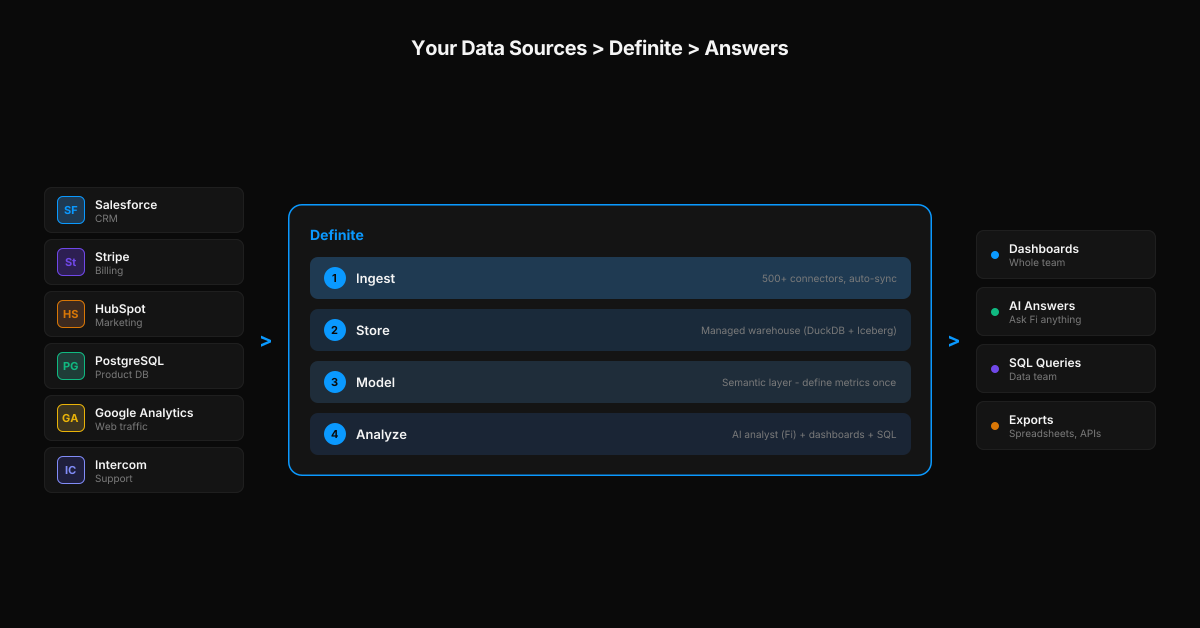
Connect Salesforce (and 500+ other sources) in minutes. Authenticate, choose your sync frequency, and data starts flowing. The same process works for Stripe, HubSpot, your product database, and hundreds of other sources.
Your data lands in a managed warehouse—no configuration required. No separate warehouse bills, no query optimization, no capacity planning. A fast, managed warehouse built on open standards (DuckDB, Iceberg) handles everything from megabytes to terabytes.
Define your metrics once. Everyone sees the same numbers. This is the part most teams underestimate. When your CEO, CRO, and VP of Sales each look at pipeline numbers, they need to see the same pipeline numbers. A built-in semantic layer lets you define ARR, MRR, churn rate, and pipeline velocity once—and every dashboard, query, and AI-generated answer uses that single definition. No more "which dashboard is the source of truth?" debates. No more three different answers to "what's our churn rate?"
Ask questions, or build the answer yourself. Fi, the platform's AI analyst, doesn't just answer questions in plain English—it can build the dashboard, create the metric definition, and update the data model. Ask "What's our pipeline by stage for Q1?" and get a working visualization, not just a text response. Prefer SQL? Query directly. Want to connect your existing BI tool? That works too.
Open standards, no lock-in. Built on DuckDB, Iceberg, Parquet, and Cube.dev. Export your data and metric definitions anytime. If you ever outgrow the platform, take everything with you.
The Questions You Can Finally Answer
With Salesforce data flowing into a unified platform, you can tackle the RevOps questions that actually matter:
Pipeline Analysis: Track stage conversion rates, deal velocity, and win/loss trends over time. See how your pipeline has evolved quarter over quarter, not just where it stands today.
Revenue Forecasting: Combine Salesforce opportunities with Stripe actuals for accurate forecasting. Compare committed deals against recognized revenue to spot gaps before they become surprises.
Churn Prediction: Join CRM data with product usage and support tickets to identify at-risk accounts before they churn. Build early warning systems that flag customers who need attention.
Customer 360: Unify CRM data with marketing (HubSpot), product (your app database), and billing (Stripe) for a complete customer view. Understand the full journey from first touch to renewal.
What It Costs
A 200-person B2B company typically pays ~$4,500/month on Definite for 6 connected sources—compared to $6,400-11,100/month for the traditional stack. That includes the warehouse, all connectors, unlimited dashboard users, the AI analyst, and the semantic layer. No separate data engineer needed to keep the pipes running.
See the comparison for your specific setup →
Salesforce Data Warehouse FAQ
Do I actually need a data warehouse for Salesforce, or is native reporting enough?
If your questions stay within Salesforce — "how many deals closed this month?" — native reports work fine. You need a warehouse when you start asking cross-source questions: pipeline velocity combined with billing data, customer health scores that factor in product usage, or marketing attribution that connects ad spend to closed revenue. Those queries require joining Salesforce with other systems, which native reporting can't do.
What's the difference between Salesforce Data Cloud (Data 360) and an external data warehouse?
Data Cloud unifies data within Salesforce's ecosystem and offers zero-copy connections to external warehouses. An external data warehouse (Snowflake, BigQuery, or an all-in-one platform like Definite) pulls Salesforce data out so you can join it with every other source in one place. Data Cloud starts at $60K/year and still requires external tooling for true cross-source analytics. An external warehouse gives you full SQL access and the ability to define metrics that span all your systems.
How much does it cost to warehouse Salesforce data?
For a 200-person B2B company with 6 connected sources, the traditional stack (Fivetran + Snowflake + dbt + Tableau + part-time engineer) runs $6,400-11,100/month. An all-in-one platform like Definite costs ~$4,500/month for the same setup, with no separate engineer needed. Run the numbers for your specific stack →
How long does it take to set up a Salesforce data warehouse?
The traditional multi-vendor approach takes 3-6 months: configuring connectors, designing warehouse schemas, writing transformation models, and building dashboards. With a unified platform, setup takes days — authenticate your Salesforce org, define your metrics, and start querying.
Can I set this up without a data engineer?
With separate tools (Fivetran, Snowflake, dbt), you'll need someone who knows SQL and understands data modeling — typically a data engineer at 10+ hours per week. With a platform that handles ingestion, storage, and modeling together, a technically comfortable ops person can manage it. The AI analyst can also help build queries and dashboards without writing SQL.
What happens when Salesforce changes its API or schema?
Schema changes in Salesforce (new custom fields, renamed objects, API version updates) break downstream pipelines. With separate tools, your data engineer troubleshoots the connector, updates transformation models, and fixes dashboards. With a managed platform, connector maintenance is handled automatically — you don't wake up to a broken pipeline.
What's hiding in your Salesforce data?
Enter your domain and we'll show you the revenue, pipeline, and forecasting questions your team should be answering - using the Salesforce data you already have.
Try it with any company domain — no signup required.
You Shouldn't Have to Build a Stack to Get Answers
Salesforce is essential for managing customer relationships, but it was never designed to be your analytics platform. For years, the only solution was to assemble a fragmented data warehouse from multiple vendors.
That approach works. It also costs $6K-11K/month, takes 3-6 months to implement, and requires ongoing engineering support to maintain.
Definite gives you a complete analytics platform—ingestion, storage, governed metrics, visualization, and an AI analyst that can build dashboards and update models—in a single system. Setup takes a 30-minute call with our team. And you don't need a data engineer to keep it running.