


Snowflake vs Definite: Which Data Warehouse Is Right for Your Startup?

If you're evaluating data warehouses for your startup, you've probably come across Snowflake. It's powerful, it's everywhere, and Fortune 500 companies run on it. But is it the right choice for your team?
Summarize and analyze this article with:
 |  |  |  |  |
|---|
Quick Comparison
| Factor | Snowflake | Definite |
|---|---|---|
| Setup Time | Weeks to months | Under 30 minutes |
| Monthly Cost | $5,000 - $20,000+ | Free - $250 |
| Team Required | Data engineer | No specialists |
| Best For | Enterprise scale, ML workloads | Startups needing analytics now |
What Is Snowflake Built For?
Snowflake is an enterprise-grade cloud data warehouse designed for massive scale and complex workloads.
Founded in 2012 and publicly traded since 2020, Snowflake has become the dominant player in cloud data warehousing. Its architecture separates compute from storage, allowing organizations to scale each independently. This makes it exceptionally powerful for large enterprises with variable workloads.
Snowflake excels in several key areas:
- Massive scale: Handles petabytes of data across multiple cloud providers
- Concurrent workloads: Supports hundreds of simultaneous queries without performance degradation
- Data sharing: Enables secure data sharing between organizations without copying data
- Snowpark: Allows data scientists to run Python, Java, and Scala directly in Snowflake for ML workflows
- Multi-cloud: Runs on AWS, Azure, and GCP with cross-cloud replication
Fortune 500 companies rely on Snowflake for good reason: it handles scale that most startups will never reach. But here's what the marketing doesn't tell you.
What Do You Actually Need to Use Snowflake?
Snowflake alone is just the warehouse. To build a complete analytics stack, you need 5-6 additional tools.
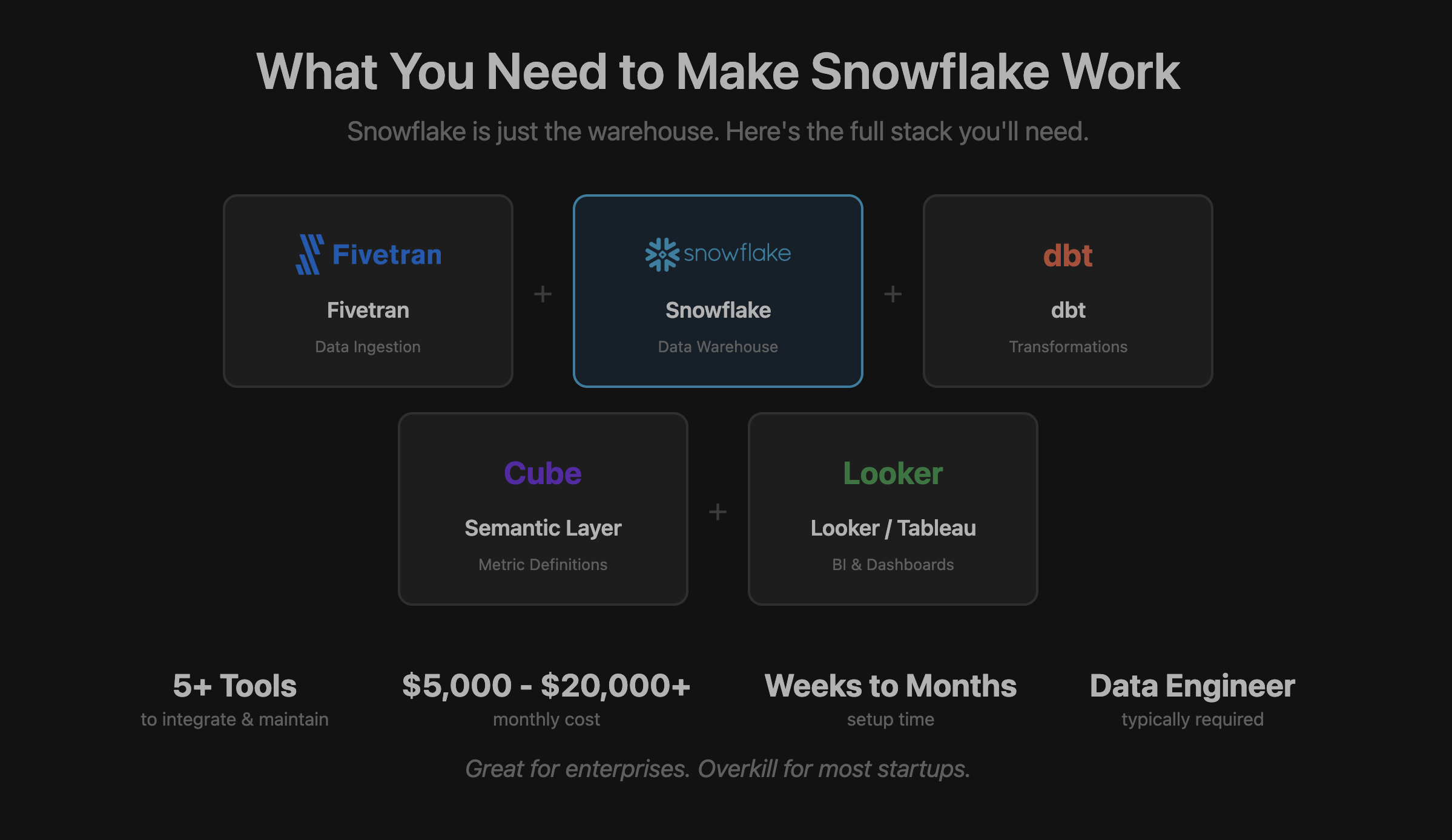
The full Snowflake stack: 5+ tools to integrate and maintain.
| Layer | Tool Examples | Typical Cost | Purpose |
|---|---|---|---|
| ETL / Data Syncing | Fivetran, Airbyte, Stitch | $500 - $2,000+/mo | Get data into Snowflake |
| Data Warehouse | Snowflake | $2,000 - $10,000+/mo | Store and query data |
| Transformations | dbt Cloud, Dataform | $100 - $500/mo | Clean and model data |
| Semantic Layer | Cube, LookML, AtScale | $500 - $2,000/mo | Define metrics consistently |
| Dashboards / BI | Looker, Tableau, Metabase | $1,000 - $5,000+/mo | Visualize and share insights |
| Embedded Analytics | Custom builds | Engineering time | Share analytics with customers |
The Hidden Complexity
Each of these tools requires:
- Separate contracts and billing: Six vendors means six invoices, six renewal cycles, and six pricing models to track
- Integration maintenance: Keeping Fivetran, Snowflake, dbt, and Looker in sync requires ongoing attention
- Version compatibility: When dbt releases a breaking change, you need to coordinate updates across your stack
- Expertise across tools: Your team needs to understand not just SQL, but also dbt's Jinja templating, Looker's LookML, and Fivetran's connector quirks
The People Cost
The real expense isn't the tooling. It's the people.
A fully-loaded data engineer costs $150,000 - $250,000 per year. For most startups, that's the equivalent of 2-3 additional engineers who could be building product instead of maintaining data infrastructure.
And one engineer often isn't enough. Complex Snowflake implementations typically require:
- A data engineer to manage pipelines and infrastructure
- An analytics engineer to build dbt models
- A BI developer to create dashboards
- An analyst to actually answer business questions
That's three to four roles before anyone starts getting insights.
How Is Definite Different?
Definite is an all-in-one data platform that includes everything you need in a single tool.
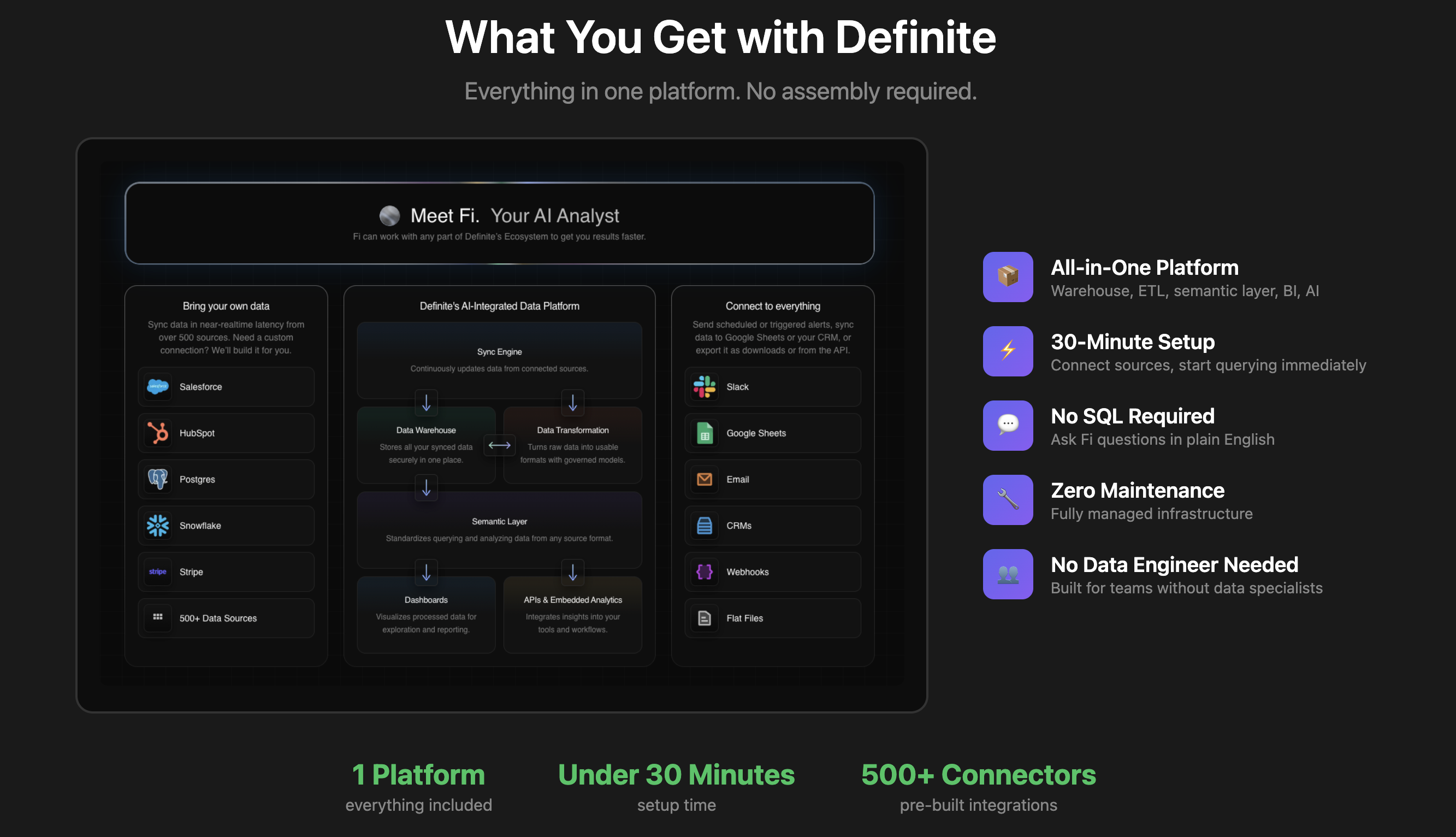
Instead of stitching together six different products, Definite combines:
- Data warehouse (built on Apache Iceberg and DuckDB)
- ETL / data syncing (500+ connectors)
- Transformations (SQL-based modeling with version control)
- Semantic layer (powered by Cube.dev)
- Dashboards and visualization (presentation-ready charts and reports)
- AI assistant (Fi)
How the Architecture Works
Definite's architecture is built on proven open-source foundations:
Apache Iceberg handles data storage. Iceberg is the same table format used by Netflix, Apple, and Airbnb. It provides ACID transactions, schema evolution, and time travel queries without the vendor lock-in of proprietary formats.
DuckDB powers fast analytical queries. DuckDB is an embedded analytical database that runs queries directly on Iceberg files. For most startup workloads, it's faster than Snowflake because there's no network overhead between compute and storage.
Cube.dev provides the semantic layer. This means you define metrics once (like "MRR" or "active users") and those definitions are consistent everywhere: dashboards, API calls, and AI queries.
The Setup Experience
You sign up, connect your data sources, and you're analyzing data in under 30 minutes.
- Connect sources: Select from 500+ pre-built connectors including Stripe, HubSpot, Salesforce, Postgres, and more
- Data syncs automatically: Definite creates your data lake and starts syncing immediately
- Ask questions: Use Fi to query data in plain English, or write SQL if you prefer
- Build dashboards: Create visualizations without leaving the platform
No Fivetran. No dbt. No data engineer required.
What Can You Do with Fi?
Fi is Definite's AI assistant that lets anyone on your team query data in plain English.
Natural Language Queries
Instead of writing SQL, you ask questions like:
- "Show me revenue by month for the last 12 months"
- "Which customers churned last quarter and what was their lifetime value?"
- "What's our conversion rate by channel, broken down by week?"
- "Compare this quarter's sales to last quarter by region"
Fi translates your questions into optimized queries, runs them against your semantic layer, and returns results instantly.
How Fi Is Different from ChatGPT
Generic AI tools like ChatGPT don't know your data. Fi does.
Fi understands your semantic layer, your metric definitions, and your data relationships. When you ask about "revenue," Fi knows exactly which table, which column, and which filters to apply because it's connected to your Cube models.
This means:
- Accurate results: Fi queries your actual data, not hallucinated numbers
- Consistent definitions: Everyone gets the same answer to the same question
- Context-aware: Fi understands relationships between tables without you specifying joins
Beyond Querying
Fi can also:
- Explain data lineage: "Where does this chart's data come from?"
- Suggest analyses: "What should I look at to understand churn?"
- Build visualizations: "Create a bar chart of this data"
- Debug issues: "Why is this number different from last week?"
Non-technical team members get answers without waiting for an analyst. Technical users move faster because they're not writing boilerplate SQL.
What Does Snowflake Cost?
Snowflake's pricing is complex and often surprises first-time users.
The Pricing Model
Snowflake charges separately for:
- Compute: Measured in "credits" consumed by virtual warehouses running queries
- Storage: Per-terabyte monthly charge for data stored
- Data transfer: Charges for moving data between regions or clouds
- Serverless features: Additional credits for features like Snowpipe, tasks, and streams
Real-World Costs
For a typical startup running analytics workloads:
| Component | Monthly Cost |
|---|---|
| Snowflake compute (X-Small warehouse, 8 hrs/day) | $1,200 - $2,400 |
| Snowflake storage (1-5 TB) | $100 - $200 |
| Fivetran (10-20 connectors) | $500 - $1,500 |
| dbt Cloud (Team plan) | $100 - $500 |
| Looker or Tableau | $1,000 - $3,000 |
| Total | $2,900 - $7,600 |
And that's before you hire anyone to manage it. With a data engineer, you're looking at $15,000 - $25,000 per month in fully-loaded costs.
The Credit Trap
Snowflake's credit-based pricing creates unpredictable costs. A poorly optimized query, an analyst who forgets to suspend a warehouse, or a spike in dashboard usage can burn through credits quickly.
Many startups get a $500 startup credit and assume they're set. They're usually out of credits within 2-3 months.
What Does Definite Cost?
Definite's pricing is straightforward: flat monthly plans based on data volume and features.
| Plan | Price | Includes |
|---|---|---|
| Growth | $0/mo | 2 data sources, 1GB storage, Fi access, dashboards |
| Platform | $250/mo | Unlimited connectors, 10GB storage, unlimited users, hourly sync |
| Enterprise | Custom | Dedicated infrastructure, SLAs, SSO, SOC 2 Type II |
No compute credits. No surprise bills. No separate charges for each tool in the stack.
What could your data tell you?
Enter your domain and we’ll show you the business questions your tools can already answer — you just can’t ask them yet.
Try it with any company domain — no signup required.
When Should You Use Snowflake?
Snowflake is the right choice when you have enterprise-scale requirements that justify the complexity and cost.
Use Snowflake if:
- You're processing petabytes of data: Snowflake's architecture shines at massive scale
- You have complex ML workloads: Snowpark enables Python/Scala processing directly in the warehouse
- You have a dedicated data engineering team: Someone needs to manage the infrastructure
- Your organization already has Snowflake expertise: Leveraging existing skills reduces ramp-up time
- You need advanced data sharing: Snowflake's data marketplace enables secure sharing between organizations
- You require multi-cloud deployment: Running on AWS, Azure, and GCP simultaneously
If these apply to you, Snowflake's power is worth the investment.
When Should You Use Definite?
Definite is built for startups and growing teams that need analytics without the infrastructure overhead.
Use Definite if:
- You need analytics now, not in three months: Setup takes 30 minutes, not weeks
- You don't have (or want to hire) a data engineer: Definite is fully managed
- You're tired of managing multiple tools: One platform replaces 5-6 products
- You want AI-powered querying for your whole team: Fi enables self-service analytics
- You're processing gigabytes to terabytes, not petabytes: Right-sized for startup scale
- You want predictable costs: Flat monthly pricing, no surprise bills
- You need to embed analytics: Built-in support for customer-facing dashboards
The biggest mistake startups make is over-engineering for scale they don't have yet. Start lean, get value fast. You can always migrate later if you need to. For a broader look at when assembling a data stack vs. adopting a data platform makes sense, see our comparison guide.
Head-to-Head Comparison
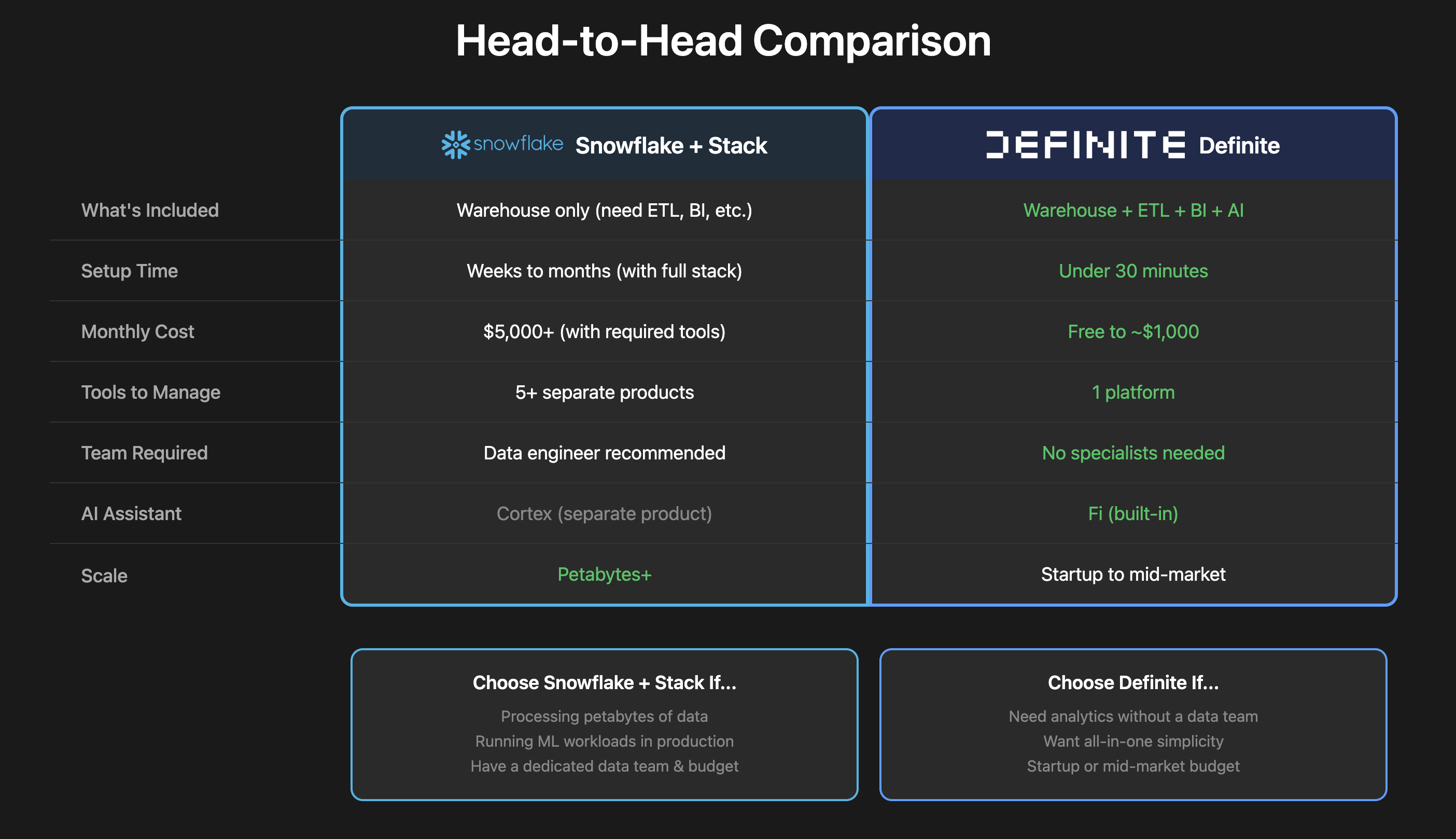
| Factor | Snowflake Stack | Definite |
|---|---|---|
| Setup time | Weeks to months | Under 30 minutes |
| Monthly cost | $5,000 - $20,000+ | Free - $250 |
| Tools to manage | 5-6 separate products | 1 platform |
| Contracts to manage | 5-6 vendors | 1 vendor |
| Team required | Data engineer + analysts | No specialists |
| AI assistant | Cortex (limited, extra cost) | Fi (built-in) |
| Connectors | Via Fivetran/Airbyte (extra cost) | 500+ native |
| Semantic layer | Requires Cube/LookML (extra tool) | Built-in (Cube.dev) |
| Pricing model | Credit-based (variable) | Flat monthly (predictable) |
| Best for | Enterprise, ML workloads, petabyte scale | Startups, lean teams, fast time-to-value |
Can You Migrate Later?
Yes. This is an important point that often gets overlooked.
If you start with Definite and eventually outgrow it, migrating to Snowflake is straightforward:
- Your data is in open formats: Definite uses Apache Iceberg, which Snowflake natively supports
- Your SQL models transfer: Standard SQL works in any warehouse
- Your metrics are documented: The semantic layer captures business logic that moves with you
Starting lean doesn't mean locking yourself in. It means getting value now while preserving optionality for the future.
FAQ
Is Snowflake overkill for my startup?
Probably. Unless you're processing petabytes of data or running complex ML workloads, Snowflake's power comes with unnecessary complexity and cost. Most startups are better served by simpler solutions until they hit true enterprise scale.
How long does Snowflake take to set up?
A production Snowflake implementation typically takes 2-4 months. This includes setting up Fivetran connectors, building dbt models, configuring a semantic layer, and creating dashboards. With a dedicated data engineer working full-time, you might cut this to 4-6 weeks.
Can Definite handle real-time data?
Yes. Definite supports streaming ingestion for sources that provide it. For most startup use cases, near-real-time (syncing every 15-60 minutes) is sufficient and included in all plans.
What if I already have Snowflake?
You can connect Definite to your existing Snowflake warehouse. This gives you Definite's semantic layer, dashboards, and Fi while leveraging your Snowflake investment. Many teams use this as a transition path.
Does Definite support SQL?
Yes. Fi is great for quick questions, but you can write SQL directly when you need more control. Definite includes a full SQL editor with autocomplete, schema exploration, and query history.
Can I migrate from Definite to Snowflake later?
Yes. Definite's lakehouse stores your data in open formats (Parquet, managed by DuckLake), your models are standard SQL, and your metric definitions live in the semantic layer, so they move with you. Starting lean doesn't lock you in.
Who Is This For?
- Startup founders evaluating data warehouse options for the first time
- Operations leaders tired of spreadsheet chaos and manual reporting
- Small data teams overwhelmed by tool sprawl and integration maintenance
- Technical founders who want to move fast without hiring specialists
- Finance leaders who need reliable metrics without waiting for engineering
If you're a Fortune 500 company with petabytes of data and a 10-person data team, Snowflake makes sense. But if you're a startup trying to make better decisions faster without adding headcount, you want something lean.