


What Autonomous Analytics Agents Actually Do: A Field Guide to the Six Jobs

If you're standing up your company's data foundation for the first time, you have an advantage the incumbents don't: nothing to rip out.
The teams that built their analytics stack three years ago are now bolting AI onto a pile of tools that were never designed for it. You get to skip that. You get to ask a better question from the start — not "how do I build dashboards," but "what could an agent do with my data if I built for it from day one?"
And if you're not greenfield — if you're retrofitting, like most teams are — the catalog below still maps to your world. You'll just be deciding what to fix first instead of what to build first.
That's the question this guide answers. Not "what is an AI agent": Google's AI Overview already gave you the textbook definition before you clicked.
This is a catalog of what autonomous analytics agents — AI agents for data analysis that act on their own — actually do, organized by the job they do, with an honest marker on each about how real it is today.
The short version
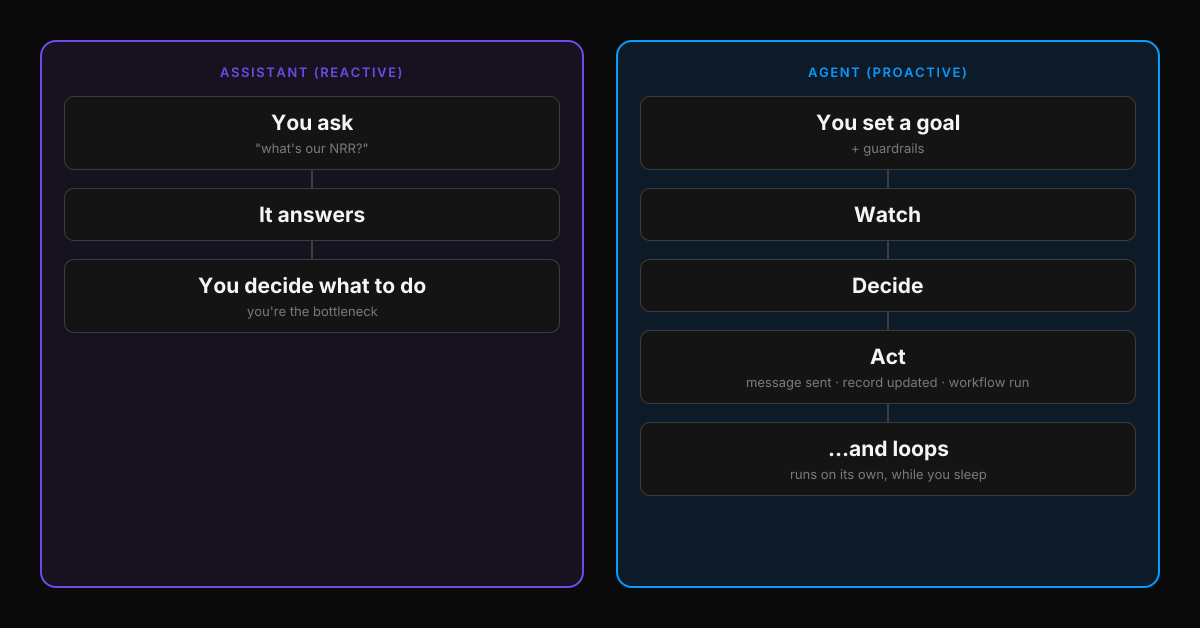
- An agent is different from a chatbot in a big way: it acts. A "chat with your data" assistant waits for you to ask a question and answers it. An agent pursues a goal — it watches, decides, and takes an action on its own. Google Cloud draws the same line: agents are proactive and goal-oriented; assistants are reactive.
- The work splits into six jobs: agents that watch, investigate, model, report, distribute, and act. This guide walks through all six with concrete before/after examples.
- The leap isn't "answers faster" — it's "answers you didn't ask for." The most valuable use cases aren't faster versions of an analyst's work; they're work that simply wasn't happening — running while you sleep, interrupting you only when something's worth knowing.
- None of it works on a messy foundation. On real-world databases, the best AI still gets the wrong number a large share of the time — unless it's given governed business context. That foundation is the whole game, and as a first-time builder, it's the thing you can get right before anything else.
Each use case below is tagged: Live today (in production now, scoped and supervised), Foundation-gated (the capability is real, but only as good as the governed data underneath it), or Emerging (works in demos and early production; maturing fast). The honesty matters — even Databricks, no AI skeptic, says fully autonomous agents are still "largely marketing, demos or research prototypes" and that the real ones run "in narrowly scoped, heavily constrained, human-supervised production environments." We'll stay on the right side of that line.
Assistant answers, agent acts
The vocabulary in this space is a mess, so here's the only distinction you need to keep straight:
- AI assistant / "chat with your data" / copilot — reactive. You ask, it answers. The decision to act stays with you. Useful, but you're still the bottleneck: you have to know what to ask.
- AI agent — proactive. You give it a goal and guardrails, and it decides what to do and does it. It can run on a schedule or a trigger, with no one watching.
- Agentic analytics — the (still vendor-coined, less-than-two-years-old) label for applying agents to the analytics workflow. The capability is real; the category name is new.
The mechanics underneath have a name too: the ReAct loop — Reason, then Act. The agent reasons about its goal, takes an action (runs a query, calls a tool), observes the result, and reasons again. Everything below is that loop pointed at a different job.
One note before the catalog: it's organized by the job an agent does — watch, investigate, model, report, distribute, act — not by industry, so you can picture it on your Tuesday. And every use case ends on an action — a message sent, a record updated, a workflow kicked off. An insight that dies in a chat window is exactly what makes "AI analytics" disappointing, so if it doesn't end in something happening, it's not on this list.
Job 1: Watch
The work that never gets done is the watching. No one has the attention to stare at forty metrics waiting for one to break. This is the job agents are built for — and it's where they're most real today.
The marquee example: catch churn the moment it moves. Before: net revenue retention is a number someone checks in the monthly business review, by which point the churn already happened. After: an agent watches net revenue churn continuously. The moment it breaks its normal pattern, it alerts the account owner in Slack and opens the account doc with the three things that changed — before it ever shows up in a renewal forecast. Live today. This is exactly the kind of scoped watch-and-act that ships in production now: point an agent at one metric and one action, with a cooldown so it never runs away.
More watching jobs:
- Stop runaway spend. Watch daily ad or cloud spend; the moment it spikes past budget, page the owner — before the invoice does. Live today.
- Guard data freshness. Watch whether a critical pipeline landed on time; if a sync is late or a row count drops off a cliff, post to the data channel and pause the dashboards that depend on it so no one makes a decision on stale numbers. Foundation-gated — the agent has to know which tables feed which decisions, which means a governed model.
- Track every cohort, not just the aggregate. This is one that was economically impossible before. A human watches the top-line number; an agent can watch the health of every customer segment, region, and plan tier overnight and surface the one cohort quietly falling apart under a healthy-looking average. Emerging.
Job 2: Investigate
When a number moves, someone has to find out why. That's hours of slicing the data by region, by channel, by cohort, by time. An investigation agent does the slicing.
The marquee example: root-cause a revenue dip. Before: revenue is down 4% on Tuesday; an analyst spends the afternoon pivoting the data twelve ways to find the cause. After: the agent decomposes the question on its own — probing by region, channel, device, and cohort — narrows it to a single broken checkout flow in one geography, and posts the finding to Slack with the affected revenue and a link to the failing step. You read the answer before you'd have finished framing the question. Live today (scoped and supervised — you still confirm before anything downstream happens).
More investigation jobs:
- Diagnose a funnel drop. Signups fell; the agent walks the funnel stage by stage, isolates the step that regressed, correlates it with a recent release, and opens a ticket tagged to the owning team. Foundation-gated.
- Explain a margin anomaly. Gross margin slipped in one product line; the agent traces it to a specific supplier's cost change and drafts the summary for the finance review. Foundation-gated.
- Hunt for what you didn't think to look for. A real example from a multi-brand commerce team: an agent analyzed customer address patterns over time to flag likely fraud and reseller abuse — a question no one had written a report for, because no one had the hours to. Emerging.
Job 3: Model
Agents don't just read your data model — they can help build and maintain it. For a first-time builder, this is the difference between a foundation that calcifies and one that keeps up with the business.
- Draft the metric the moment you need it. You describe "qualified pipeline" in plain language; the agent writes the SQL, proposes the definition, and adds it to the governed semantic layer for review — so the next person who asks gets the same number. Foundation-gated.
- Heal the model when the source changes. A SaaS connector adds a column or renames a field; instead of a silently broken dashboard three weeks later, the agent flags the schema change and proposes the model update. Emerging.
- Backfill a missing dimension. The marketing data has campaign IDs but no channel grouping; the agent proposes the mapping and writes it back as a maintained dimension rather than a one-off spreadsheet VLOOKUP. Emerging.
A word of honesty here: an agent that autonomously rewrites your data models with no one watching is not something you should want, and it's not shipping. The real version is an agent that proposes and a human that approves — which, with a governed foundation, is genuinely useful today.
Job 4: Report
The recurring report is the most automatable thing in analytics and somehow still the most manual. Someone rebuilds the same deck every week.
The marquee example: the Monday report builds itself. Before: every Monday, ops pulls from the product database, payments, and the CRM, stitches it into a sheet, flags the at-risk accounts by hand, and writes the summary. Half a day, gone, every week. After: the agent assembles the same report on schedule, flags the accounts that moved, drafts the narrative of what changed and why — you edit the judgment, not the tables — and drops it in the channel before the standup. Foundation-gated — it only works if "at-risk account" means the same thing every week, which is what a governed definition guarantees. With that foundation in place, one customer's ops team cut 40+ hours of manual reporting a month.
More reporting jobs:
- First-draft the board pack. The agent assembles the standard metrics, writes the commentary, and flags the numbers that will get questions — leaving you to edit judgment, not assemble tables. Foundation-gated.
- Narrate the weekly business review. Not just the charts, but the sentences: "New logo revenue beat plan, driven by mid-market; expansion lagged for the second week, concentrated in one segment." Foundation-gated.
Job 5: Distribute
An answer that lives in a dashboard no one opens is wasted. The distribution job is about putting answers where decisions actually happen.
- Answer in Slack, from governed numbers. Someone asks "what's our net revenue retention this quarter?" in a channel; the agent answers from the certified metric, not a guess — so the number in chat matches the number in the board deck. Foundation-gated.
- Sync the flagged list to where the work happens. The at-risk accounts the agent found don't just sit in a report — they're pushed to the CRM as tasks for the owning reps. Live today.
- Bring governed data into the tools you already live in. A growing number of operators run their analysis through an AI agent in their existing environment — Claude, Cursor, an IDE — connected to governed data over MCP, bouncing between questions without ever opening a dashboard. One founder we work with runs much of his day-to-day BI this way. Live today.
This last one is the shift worth internalizing as a first-time builder. The interface to your data is moving — from dashboards you remember to check, to agents that come to you. Dashboards aren't dead, but they're no longer the only front door, and increasingly not the main one. One team that used to open the day with six separate morning email reports now starts with answers instead of tabs.
Job 6: Act
The job that separates an agent from everything that came before: it writes back. It doesn't stop at the insight — it changes something in another system.
The marquee example: classify and write back. A real example from a RevOps team: every new company needs an industry classification, and someone was looking each one up by hand. The agent now takes the company's URL, classifies it against the standard industry taxonomy, and writes the fields straight back into the CRM. No report, no export, no human re-keying — the work is just done. Live today (scoped to a single field, a fixed taxonomy, and a governed write target).
More acting jobs:
- Adjust within guardrails. When spend crosses a threshold, the agent doesn't just alert — it pauses the campaign or caps the budget, inside limits you set, and logs what it did. Emerging (and the kind of action you want bounded tightly).
- Trigger the workflow. A churn-risk signal kicks off the retention play — the task, the email draft, the discount approval request — instead of waiting for someone to notice the dashboard. Foundation-gated.
- Automated follow-up. A real example from a software company: agents handle call-recording analysis and automated customer follow-up, turning a post-call insight into an actual next touch. Emerging.
The pattern across this whole job: real agents act with approval gates and inside guardrails. That's not a limitation to apologize for — it's the design. The market doesn't want maximum autonomy; it wants bounded autonomy it can trust.
Just faster, or newly possible?
Read back through the catalog and you'll notice two different kinds of use case, and it's worth separating them.
Just faster — the agent does a job a human already does, in less time. Root-causing the revenue dip, building the Monday report, drafting the board pack. Real value, but you can picture the analyst it replaces an afternoon of.
Newly possible — the agent does a job no human was ever going to do, because the economics never worked. Watching the health of every cohort every night. Re-checking every metric definition when any source changes. Investigating questions no one had time to write a report for. These aren't faster versions of existing work; they're work that simply wasn't happening.
The first bucket is how you'll justify an agent to your CFO. The second is why this moment is actually different. As a first-time builder, you're not just buying back analyst hours — you're enabling a class of monitoring and investigation your competitors on older stacks can't economically run.
Why the chatbot you tried (or will try) gets it wrong
Here's the part that explains every disappointing "AI analytics" demo.
The reason a chatbot confidently returns the wrong number isn't that the model is dumb. It's that your data has four definitions of "revenue" and the model has no way to know which one you meant. On the BIRD benchmark — a test of AI writing SQL against real, messy databases — giving the model curated business context lifted its accuracy by roughly 20 points over leaving it to read raw tables alone, and even then it trailed the 93% humans score. The absolute numbers climb as models get better; the gap doesn't — a smarter model still can't know which of your four definitions of "revenue" you meant. The model isn't the bottleneck. The missing context is.
That "curated business context" has a name: a semantic layer (sometimes an ontology layer) — the governed place where "revenue," "active customer," and "qualified pipeline" each mean one specific thing. When an agent reads from that, it can't guess, because the definition is fixed. When it reads from raw tables, it guesses, and it guesses confidently. (We go deep on this in why AI analysts need an ontology layer.)
This is the answer to the question every first-time builder should be asking: was the failed AI demo the tool's fault, or my data's? Usually it's neither — it's the missing layer between them. Here's the useful part: the layer is buildable. It's the thing you get to put in first.
What it actually takes — and why most stacks can't
Every use case in this guide depends on the same foundation. An agent can only act on a system that is:
- Integrated — the agent can see product, payments, CRM, and marketing data in one place, not stranded in six tools.
- Governed — metrics mean one thing, so the agent's answers match the board deck and each other.
- Writable — the agent can take an action (update a record, trigger a workflow), not just read and summarize.
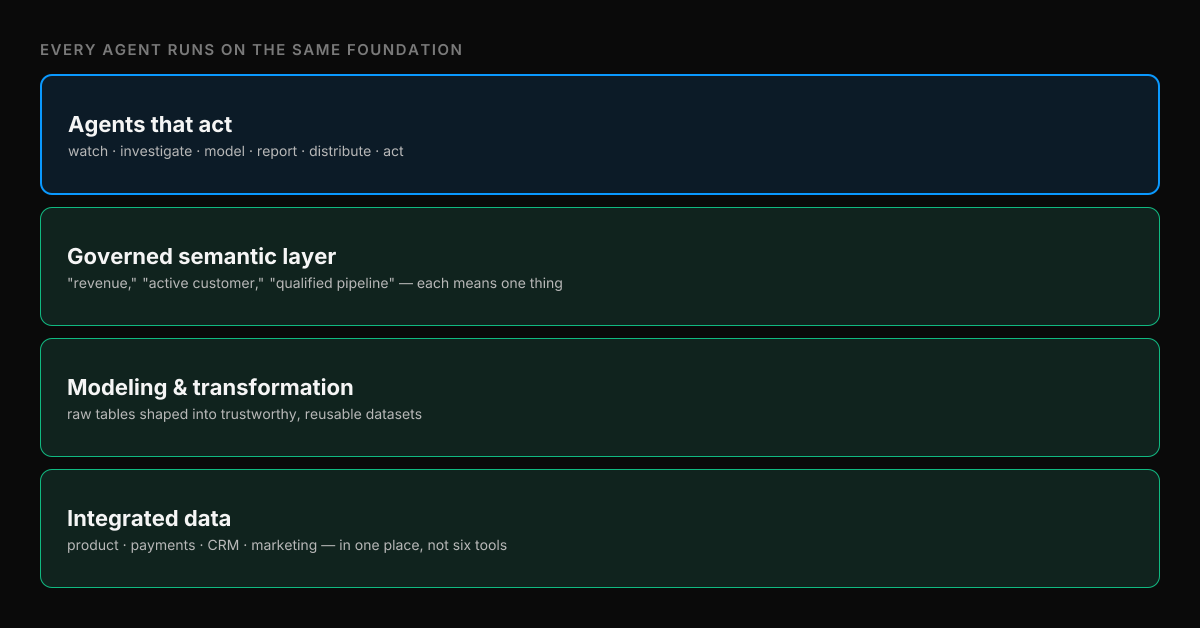
This is the part the rest of the internet skips. Every competitor's use-case list quietly assumes the agent is reading a clean, connected, governed system. Most teams don't have one — they have a stack that was assembled tool by tool, where the agent can read a little and act on nothing.
The first-time builder's advantage is that you can build for this directly instead of retrofitting it. An all-in-one platform like Definite exists for exactly this reason: ingestion, modeling, the governed semantic layer, and the agents that act on it are one system, not five you wire together and hope hold. You get the governed foundation without standing up a data-infrastructure team to maintain it — one RevOps lead built Saturn's investor-grade foundation solo, no analytics engineer required.
Build the foundation so the agents work — then point them at the six jobs above, one scoped action at a time.
FAQ
What's the difference between an AI agent and "chat with your data"? "Chat with your data" is reactive — you ask, it answers, you decide what to do. An agent is proactive — you give it a goal and guardrails, and it watches, decides, and acts on its own. The asking model keeps you as the bottleneck; the agent removes it for the jobs you can bound safely.
Is any of this real today, or is it all demos? Both, which is why each use case above is marked. Scoped watch-and-act, root-cause investigation, write-back to a CRM, and answering from governed metrics are in production now — supervised and bounded. Fully autonomous, hands-off, end-to-end analytics is still mostly demo-ware; even the biggest data platforms say so. Trust the ones marked "Live today"; treat "Emerging" as a roadmap.
Can an agent replace the weekly report my ops team builds by hand? Yes — this is one of the most concrete wins. The catch is that it only works if the report's terms ("at-risk account," "active user") have governed definitions, so the agent assembles the same thing a human would every week instead of a slightly different thing each time.
Do autonomous agents replace analysts? No, and the framing matters. Agents take the grunt work — the watching, the slicing, the rebuilding of the same report. The analyst does the thinking: deciding what's worth investigating, judging whether the agent's finding holds, designing the metrics the agent maintains. The agent does the job no one wanted; the human does the job that needs a brain.
Was my failed AI analytics tool the tool's fault or my data's? Usually neither — it was the missing governed layer between them. AI guesses confidently on raw, inconsistent data and gets it right when it reads from defined metrics. As a first-time builder, that layer is the thing to get right before anything else.
Where to start
You don't need all six jobs on day one. You need a governed foundation and one scoped agent doing one job well — usually a watch-and-act on the metric that, if it broke quietly, would hurt the most.
Build the foundation so agents can actually work, point one at a single metric and a single action, and let it earn the next one. The teams retrofitting AI onto three-year-old stacks would love to be where you are: at the start, building for agents from the ground up.