


Best Data Warehouse for Startups in 2026
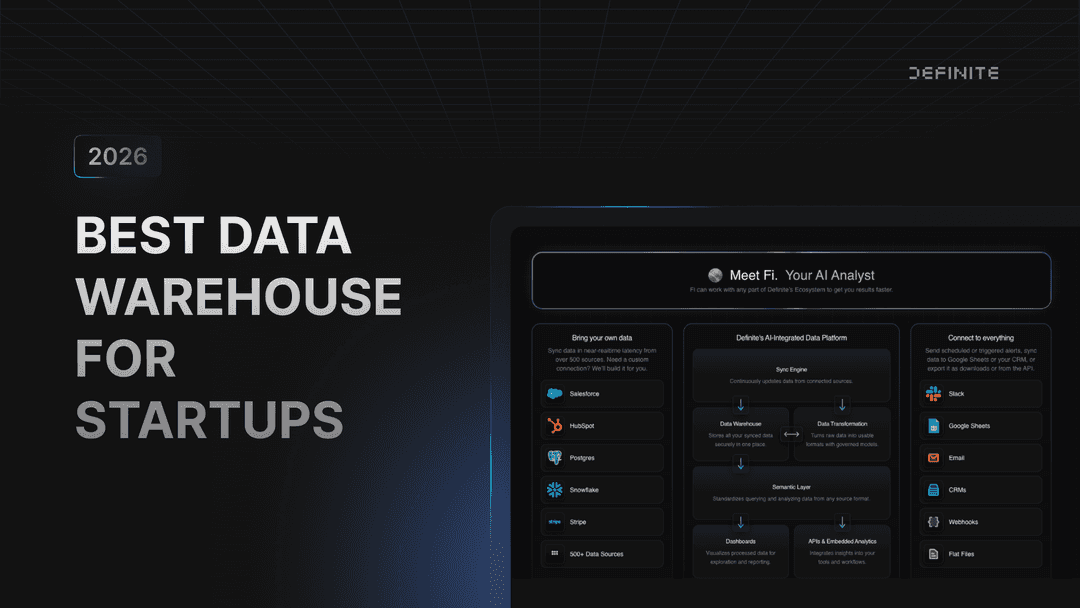
Your startup is growing. Data is coming in from Stripe, your product database, maybe Salesforce or HubSpot. And right now, it's scattered everywhere. Finance pulls numbers from one place. Sales pulls from another. Product has their own source. When you sit down for a team meeting, nobody's numbers match.
You need a single source of truth. But you're not ready for Snowflake, and you're definitely not hiring a data engineer just to wire everything together.
Summarize and analyze this article with:
 |  |  |  |  |
|---|
Table of Contents
- The Scattered Data Problem
- When Do You Need an Enterprise Data Warehouse?
- The Traditional Stack Problem
- The "Just Use Postgres" Trap
- What Startups Actually Need
- How Definite Solves This
- Who Is This For?
- Get Started
The Scattered Data Problem
Most growing startups hit the same wall: data is everywhere, and none of it agrees.
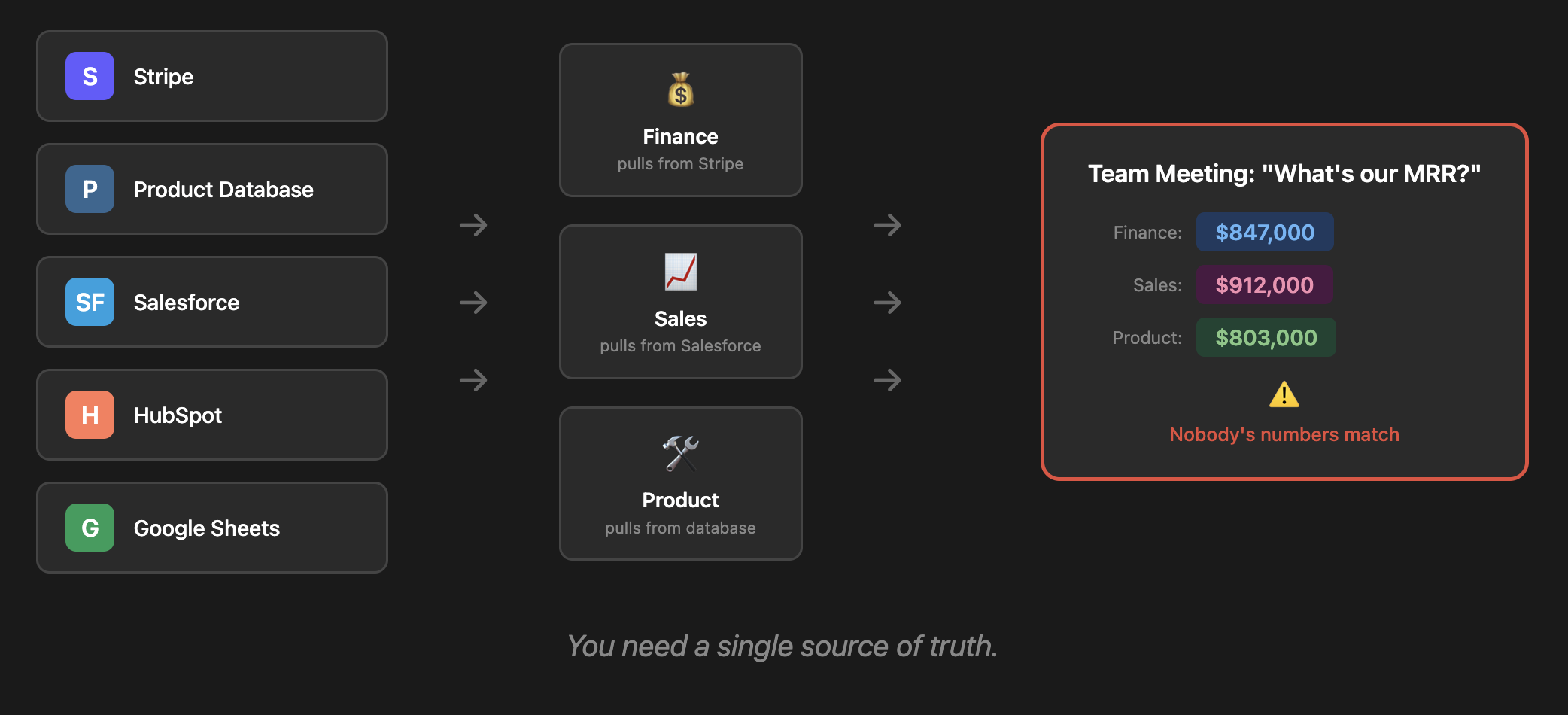
Finance is pulling revenue numbers from Stripe. Sales is pulling pipeline data from Salesforce. Product is querying the database directly. Marketing has their own spreadsheet. And when everyone shows up to the team meeting with their version of "the numbers," nothing matches.
This isn't a people problem. It's an infrastructure problem. You need a single source of truth: a data warehouse.
But here's where most startups get stuck. They Google "data warehouse" and end up looking at enterprise solutions they don't need, or DIY approaches that become unmaintainable.
When Do You Need an Enterprise Data Warehouse?
Enterprise data warehouses like Snowflake, BigQuery, and Databricks make sense when you're processing petabytes of data, running complex ML workloads, or supporting thousands of concurrent users.
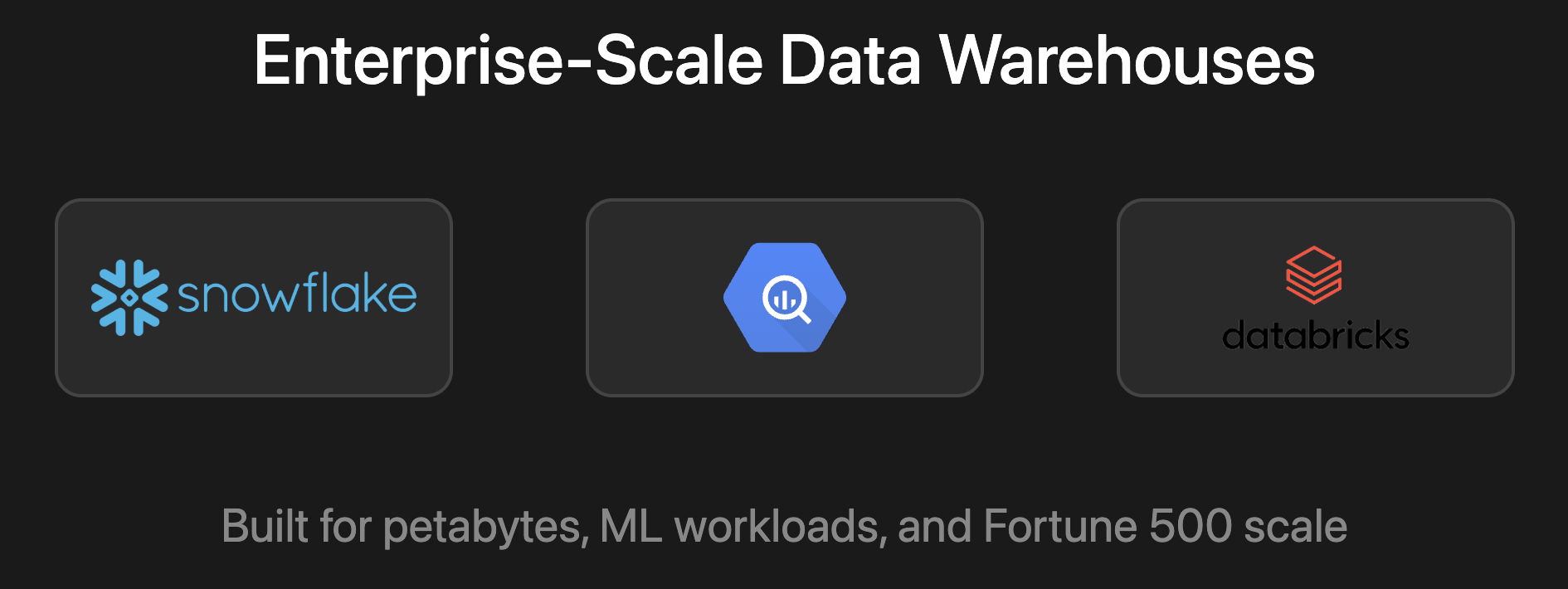
These are powerful tools. Fortune 500 companies run on them. But they're built for enterprises, and most startups aren't there yet.
Signs you might need an enterprise warehouse:
- Petabytes of data (not gigabytes)
- Complex ML/AI workloads in production
- Thousands of concurrent users
- Dedicated data engineering team
- Six-figure data infrastructure budget
If that's not you, keep reading.
The Traditional Stack Problem
Here's what nobody tells you about Snowflake: it's just the warehouse. To actually use it, you need a full stack.
| Layer | What You Need | Example Tools |
|---|---|---|
| ETL / Data Syncing | Move data into the warehouse | Fivetran, Airbyte, Stitch |
| Data Warehouse | Store and query data | Snowflake, BigQuery, Redshift |
| Transformations | Model and clean data | dbt, Dataform, SQLMesh |
| Semantic Layer | Define metrics consistently | Cube, LookML, MetricFlow |
| Dashboards / BI | Visualize and explore | Looker, Tableau, Metabase |
| Embedded Analytics | Share insights externally | Preset, Sigma, custom builds |
That's six different tools. Six different bills. Six integrations to maintain. And probably a full-time data engineer just to keep everything running.
Planning ahead is smart. Paying ahead for problems you don't have yet is just expensive.
The enterprise stack makes sense when you have the scale and team to manage it. For most startups, it's over-engineering.
The "Just Use Postgres" Trap
On the other end of the spectrum, some people will tell you to just query your production database or spin up a Postgres instance.
This works... until it doesn't.
Problems with the DIY approach:
- Performance limits: Analytical queries slow down your production database
- No modeling layer: You end up with a jungle of one-off SQL queries
- No single source of truth: Different people write different queries for the same metric
- Maintenance burden: Someone has to keep the spreadsheets and scripts running
You'll hit these walls fast, and you'll end up rebuilding everything anyway.
What Startups Actually Need
Here's the reality: most startups don't need enterprise infrastructure. What you actually need is something that:
- Brings all your data together in one place
- Lets you model it properly with consistent metric definitions
- Gets you to answers fast without requiring SQL expertise
- Doesn't require a data team to set up and maintain
That's a very different set of requirements than "handle petabytes of data."
How Definite Solves This
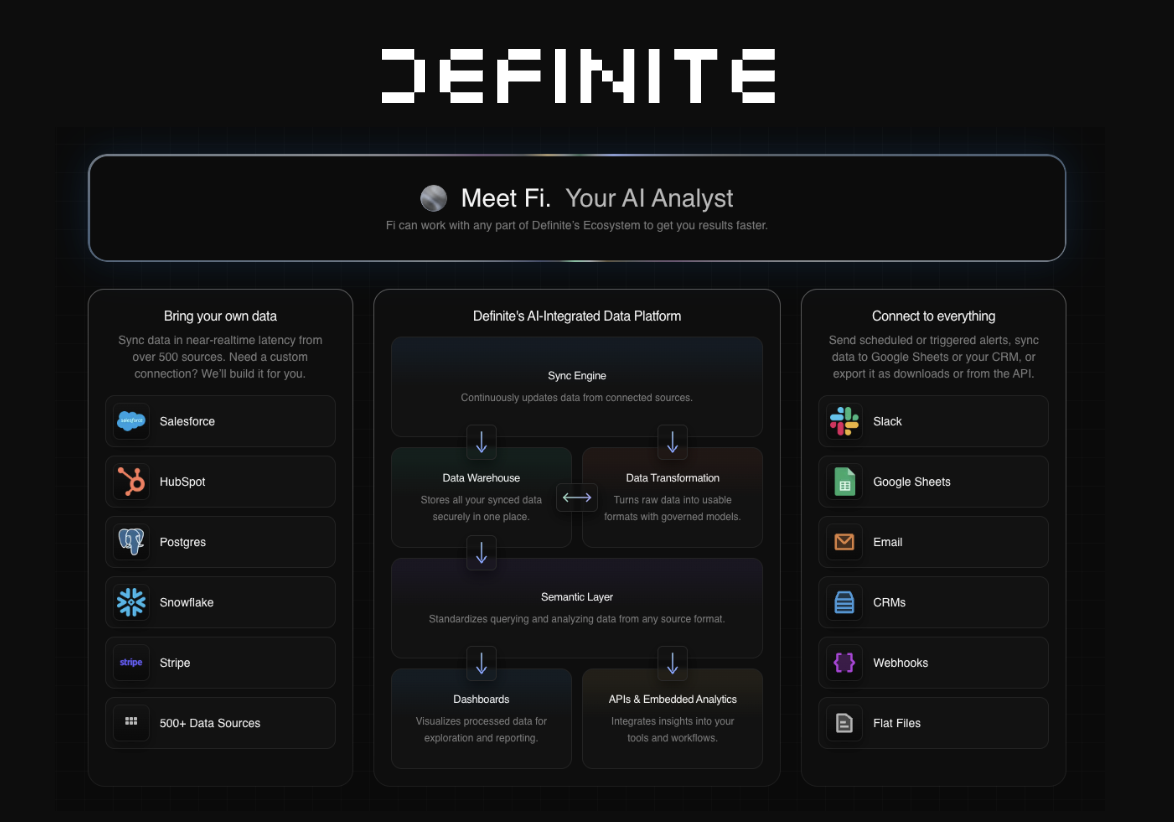
Definite combines everything into one platform: data syncing, warehouse, transformations, semantic layer, dashboards, and embedded analytics. All AI-integrated.
[Add screenshot: definite-all-in-one.html full graphic showing Traditional Stack VS Definite]
What you get with Definite:
| Component | What It Does |
|---|---|
| Data Syncing | Connect 500+ data sources with pre-built connectors |
| Data Warehouse | Managed storage, no infrastructure to maintain |
| Transformations | Model your data with SQL or let Fi help |
| Semantic Layer | Define metrics once, use them everywhere |
| Dashboards | Build visualizations without SQL |
| Embedded Analytics | Share insights via API or embeds |
| AI Assistant (Fi) | Ask questions in plain English, get answers |
The cost comparison:
| Approach | Monthly Cost | Setup Time | Ongoing Maintenance |
|---|---|---|---|
| Enterprise Stack (6 tools) | $5,000 - $20,000+ | 3-6 months | Full-time data engineer |
| DIY Postgres | $100 - $500 | 1-2 months | Significant engineering time |
| Definite | Free to start, ~$1,000/month for most teams | Under 30 minutes | Minimal |
The real savings aren't just the subscription cost. You're not hiring a full-time data engineer just to keep the lights on.
Who Is This For?
- Funded startups that need analytics but aren't ready for a data team
- Founders who want dashboards without learning SQL or hiring specialists
- Small data teams replacing Snowflake + Fivetran + dbt + Tableau with one platform
- Operations leaders tired of conflicting spreadsheets and manual data pulls
If you're a funded startup pushing petabytes of data with a dedicated data team, Snowflake or Databricks might make sense. But if you're like most startups, trying to make better decisions faster without adding headcount, you want something lean, fast, and all-in-one.
Get Started
Connect your data sources, define your metrics once, and everyone on your team (technical or not) can get answers. Fi lets you ask questions in plain English. No SQL required.
We can get you set up in under 30 minutes, and our team will help fill in any gaps so you can focus on analysis, not infrastructure.
- Start free: ui.definite.app
- Learn more: definite.app
- Read the docs: docs.definite.app
- Questions? Email hello@definite.app
Data doesn't need to be so hard
Get the new standard in analytics. Sign up below or get in touch and we'll set you up in under 30 minutes.